City centre · Qingyang, above Tianfu Square station
Tianfu Square: the centre point, and the four sides of it
Most Chengdu trips cross this square without meaning to — Lines 1 and 2 meet underneath it. Above ground it is a slab of pale granite with the sun-bird roundel set into the paving, the Mao statue standing to the north and three museums within a two-minute walk. Nobody queues for it and there is nothing to buy, which is exactly why it is useful: it is where you get your bearings.

Prices and hours checked 28 October 2026四川科技馆 (its own site, for museum hours); the square's layout and station exits from zh-Wikipedia and 四川在线
What this square actually is
Tianfu Square is not a monument and not a market. It is the middle of Chengdu: the point from which the city's roads are numbered, sitting on the axis of the old imperial city, with 88,368 square metres of granite laid over what was the 皇城 before it was demolished in the twentieth century. You will not find a gate, a ticket office or a queue. You will find people crossing it quickly, families sitting on the warm stone in the evening, and a great many students being photographed in front of the statue.
The design is doing something deliberate. The pale paving carries an enormous sun-bird roundel — the gold foil ornament excavated at Jinsha — and around it a Taiji arrangement, with twelve carved columns standing along the edges. Reading it as a car park with decoration misses the point; it is a piece of city branding laid in stone, and Chengdu is unusually direct about that.
The square's real function is wayfinding. Everything a first-time visitor needs in the centre sits within two hundred metres of it, and because the metro station underneath has nine exits, the difference between a good and a bad twenty minutes here is which one you take.
The four sides, and the level below
- 01
North — the statue, the fountain and the science museum
The white marble Mao statue stands on the axis facing south, with the ornamental fountain on the paving directly in front of it, and the former 毛泽东思想胜利万岁展览馆 behind — now the Sichuan Science and Technology Museum. The museum is free and needs a booking; it opens Tuesday to Sunday, 09:20 to 17:00, with last entry at 16:30. Closed Mondays.
- 02
West — Chengdu Museum, and the lane to People's Park
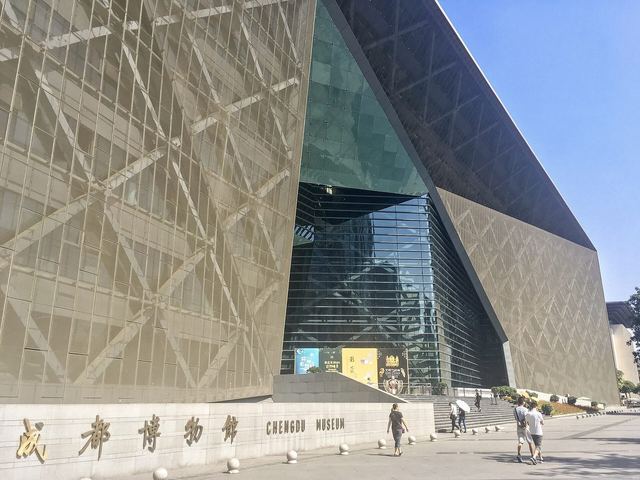
The city museum's dark, slatted block faces the square on the west side. Behind it a lane of Xinjiang food stalls — lamb skewers, naan, a lot of smoke — runs west and comes out at People's Park, which is about ten minutes on foot and is where the teahouses are.
- 03
East — Chunxi Road and Taikoo Li
The road east of the square runs to Chunxi Road and, past it, Taikoo Li: fifteen to twenty minutes on foot, or one stop on Line 2. This is the shopping direction.
- 04
South — Renmin South Road
The avenue running south from the square is the spine of the modern city: Tianfu Avenue eventually, the financial district beyond, and the Jin River if you keep going.
- 05
Below — the sunken plaza
The sunken level is not an east-side feature. It has entrances on all four sides of the square, and the widest stair is in the middle, beside the sun-bird roundel. Down there is a shopping street that connects most of the metro exits, so you can cross the square underground without surfacing.
Practical
- Entry
- Free; no ticket, no gate, open around the clock
- Metro
- Lines 1 and 2 interchange; nine exits, D is the step-free one
- Toilets
- None inside the paid area of the station — use the malls above the concourse
- Science museum
- Tue–Sun 09:20–17:00, last entry 16:30; free, book ahead; closed Mondays
- Chengdu Museum
- On the west side; hours are on the museum's own site and change with exhibitions
- Best hour
- After 19:00 — the stone cools, the fountain runs, the statue is lit
- Time needed
- 15 minutes to cross and orient; half a day if you take in a museum
Station facts checked against the 天府广场站 entry on 28 October 2026; science museum hours from its own site. The station's exit lettering has changed as the underground mall was built out — follow the signs on the concourse rather than a list on a blog, including this one.
The evening version
After dark the square changes character. The daytime crowd of people cutting across it on the diagonal is replaced by families, skateboarders and couples sitting on the low edges of the fountain, and the axis north to the statue becomes the photograph everyone takes. The fountain's jets are lit and run in time to music at intervals rather than continuously, so hang around for ten minutes rather than arriving at a fixed time — there is no published timetable to plan around.
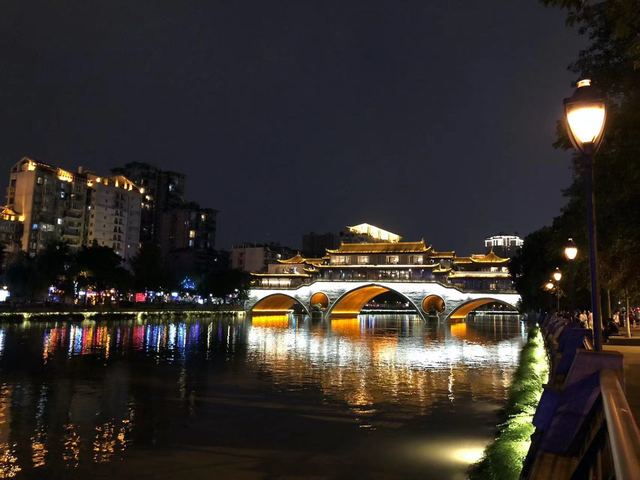
This is also the easiest place in the city to start a night. Chunxi Road and Taikoo Li are one stop, or a fifteen-minute walk, east; the Jin River and Anshun Bridge are a short taxi south-west; and the metro is running until around 23:00 in every direction. Buy something from the underground food street on the way through and you have done the centre of Chengdu in an evening without paying for anything except dinner.
Questions people actually ask
Is Tianfu Square worth visiting?
As a stop of ten or fifteen minutes, yes — it is the geographic centre of the city, the sun-bird paving and the Mao statue are worth looking at once, and three museums are on its edges. As a destination for an afternoon, no: there is nothing to do here that you cannot do better elsewhere, and the square's value is that it orients you before you go somewhere else.
Which metro exit should I take at Tianfu Square?
It depends on what you came for, and the station has nine exits, so read the signs on the concourse instead of memorising a number. For the Mao statue and the science museum, take the exit signed for the north side (Renmin Middle Road / 人民中路); for Chengdu Museum walk west from any exit on the square itself; for the underground shopping street, stay inside the concourse and follow the mall signs. Exit D is the step-free one.
Are there toilets at Tianfu Square station?
Not inside the paid area. The station connects directly to the malls and the underground shopping street, and those have toilets; the station itself does not. Plan for that if you are changing lines here with children.
When does the fountain run?
There is no published timetable, so nobody quoting an exact hour is quoting an official source. The fountain on the west side runs in intervals during the day and is lit in the evening; the practical approach is to arrive after 19:00 and wait one interval rather than to plan around a time.
What was on this site before the square?
The imperial city — the 皇城 — stood on this axis for centuries, and its gate and walls survived into the twentieth century before being cleared. The square as it looks now dates from the 2007 rebuild that accompanied the metro station, which is when the sun-bird roundel, the sunken plaza and the totem columns were added.