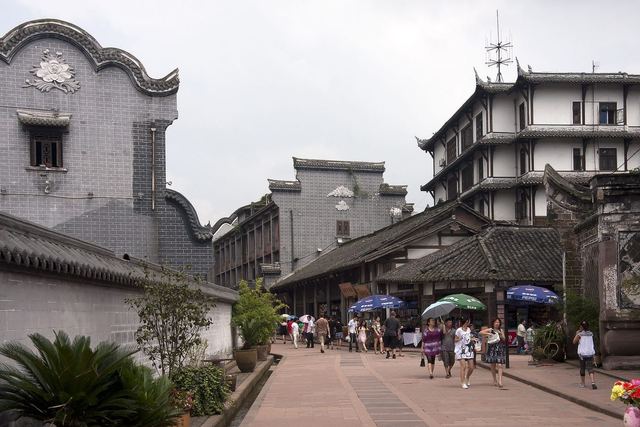
Shuangliu District · about 40 km south of the centre
Huanglongxi: the old town you can do in half a day
A Ming-and-Qing street town on the water, forty kilometres out of Chengdu and free to walk into. The draw is not a single sight — it is a kilometre of stone paving, wooden shopfronts leaning over the river, three temples and a magistracy that once answered to three counties at once. Come on a weekday morning and you get the town; come on a holiday afternoon and you get the crowd.

Prices and hours checked 28 October 2026Huanglongxi attraction records on 本地宝 and 去哪儿 (town layout, temples, all-day access); the Metro Line 5 + bus 541/S18 route from the 飞猪 destination page
What the town is
Huanglongxi is one long street, paved in stone, running beside water, with seven lanes hanging off it and a set of wooden buildings that have been repaired often enough that no single date applies to all of them. It has been a settlement for well over a thousand years, and it was a river port before it was a tourist town — which is why the street bends with the bank instead of running straight.
Three temples sit along it: 古龙寺, 镇江寺 and 潮音寺. None is a major monument and none charges separately; they are working neighbourhood temples, and the reason to step into 古龙寺 is the courtyard with its old banyan and the Qing stage at the back. The oddity is 三县衙门, the three-county magistracy: the town sat on the corner of 华阳, 彭山 and 仁寿 counties, so the three of them kept one office here rather than three — a single yamen for a place where a street could change jurisdiction.
The rest of the town is what old Chinese water towns are: shopfronts selling the same six snacks, rickshaws, a few courtyards open to visitors, and a stone quay where the boats used to come in. That is either the charm or the problem depending on the hour you arrive.
Getting there without a car
- 1
Metro Line 5 to Huilong (回龙)
Ride Line 5 to its southern end at Huilong. It is a long ride from the centre — the line runs straight down the axis — and it puts you in the far south of the city rather than in the countryside.
- 2
Bus 541 or S18 to Huanglongxi
From Huilong, take bus 541 or S18 to Huanglongxi bus station (黄龙溪客运站). Both are local routes rather than coaches, so they stop often; the ride is the slow half of the journey.
- 3
Then 500 m on foot
The bus station is about 500 m from the old street. Follow the signs rather than a map — the new town around the station is laid out for cars and the old street entrance is easy to miss from the road.
Practical
- Entry
- Free — no ticket for the old street or the temples
- Hours
- The street is open all day; shops and temples keep shorter hours
- Metro route
- Line 5 to Huilong, bus 541 or S18, then about 500 m on foot
- Other routes
- 819 + 821 via Huayang, or 808 from Shuangliu bus station
- Driving
- About 40 km; car parks at the edge of the old town rather than inside it
- Best time
- Weekday morning — the town is empty until about 10:00 and again after 16:00
- Worst time
- Public-holiday afternoons, when the main street is shoulder to shoulder
- Time needed
- 3–5 hours; two if you only walk the street and eat
Access and routes checked 28 October 2026. The 819 + 821 route via Huayang and the 808 from Shuangliu bus station are the older options and still run; fares change, so none are printed here.
What to eat, and where the street is at its best
The town's signature dish is 一根面 — one noodle, pulled as a single strand and served in a bowl, which is as much theatre as food. The rest is standard Sichuan river-town eating: 焦皮肘子 (braised pork hock with crackling), 珍珠豆花 (soft tofu in a clear broth), and 黄辣丁, the small yellow catfish from the river, usually done in a chilli broth. Portions are large and prices are ordinary, which is one of the few things about a Chinese old town that has not been optimised.
Eat on the side lanes rather than the main street. The main street's restaurants are the ones with the touts outside; one lane back the tables are the same and the noise is a third of it. Late morning is the best slot — the kitchens are working but the tour buses have not arrived.
The street itself is at its best at the two ends of the day. Before ten, when the shutters are still coming up, you get the stone paving, the river and nobody in the frame. After four, when the day-trippers leave, the light drops and the town goes back to being a place where people live — which is the version of it worth the journey.
Is it worth the trip?
Yes, if you want an old town and have half a day. No, if you are choosing between this and something you cannot see elsewhere in China — Huanglongxi is a good example of its type, not a unique one, and anyone who has been to a canal town in Jiangnan will recognise the format immediately.
What makes it work is the price and the access: no ticket, no reservation, a metro line and a bus, and a town you can walk end to end in under an hour. Pair it with something on the same side of the city — a Shuangliu meal, the airport run — or keep it as the low-effort day after a long one. The panda base sits 16km north of the centre, so it does not combine with this.

Questions people actually ask
Is Huanglongxi Ancient Town free?
Yes. There is no ticket for the old street and none for the three temples along it. You pay for food, for anything you buy, and for transport; the town itself is open and free.
How do I get to Huanglongxi from Chengdu by public transport?
Metro Line 5 to Huilong (回龙), then bus 541 or S18 to Huanglongxi bus station, then about 500 metres on foot to the old street. The older alternatives are the 819 to Huayang followed by the 821, or the 808 from Shuangliu bus station. Allow an hour and a half each way from the centre.
How long should I spend at Huanglongxi?
Three to five hours covers the street, the temples, the magistracy and a meal. Two hours is enough if you only want to walk the main street and eat; the town is small and there is no route to plan.
When is the fire-dragon dance?
Over the first lunar month, from the second day to the fifteenth — usually late January to early March, moving with the lunar calendar. It is a festival event with fireworks and a lit dragon, not a scheduled show, and it does not happen outside that window.
Is Huanglongxi worth visiting compared with Luodai?
They are different towns with the same format. Huanglongxi is on water with a stronger riverside street; Luodai is a Hakka town with four guild halls and a better story. Huanglongxi is further out and slower to reach; Luodai is closer to the city and easier by metro. Pick one rather than doing both, unless you have a car and a spare day.