West Chengdu · Qingyang, next to Du Fu's Cottage
Huanhuaxi Park: the free park that makes the cottage worth a half-day
Huanhuaxi is what most visitors skip and most Chengdu residents use: thirty-two hectares of hill, lake and wetland, free, open from six in the morning, ten minutes' walk from Du Fu's Cottage. It is not a garden you tour. It is a park people run in, drink tea in and get married in — and going through it turns a forty-minute museum stop into an afternoon.

Prices and hours checked 28 October 2026Park layout and history from zh-Wikipedia and the Chengdu park authority; hours cross-checked against two listings that disagree by an hour — the earlier closing time is the one this page plans for
What is actually in it
Three set pieces and a lot of in-between. 万树山 — Ten Thousand Trees Hill — is the artificial mound at the heart of the park, planted densely enough that the paths through it feel like a wood rather than a landscape scheme. 沧浪湖 is the lake beside it, about 43,000 square metres of water, with the usual Chengdu arrangement of tea tables, willows and stone bridges around the edge. 白鹭洲 is the wetland island at the far side, where the herons that give it its name actually stand.
Then there is 诗歌大道, the poetry avenue: a broad paved walk lined with carved steles carrying lines by Du Fu, Li Bai and the long list of poets who wrote about Sichuan. It sounds like the kind of thing that exists for a plaque and a photograph, and partly it is — but it is also where the park is busiest in the morning, because it is flat, shaded and long enough to walk properly.
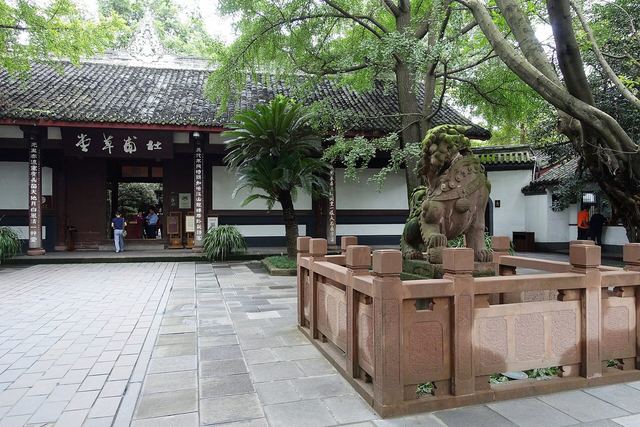
The park was built in 2002 and opened in 2003, deliberately as the setting for the cottage rather than as an attraction in its own right. That is still how it works: the cottage tells you who Du Fu was, the park shows you the landscape he was writing about, and the Sichuan Museum next door gives you the objects. All three in one afternoon is a normal Chengdu half-day.
Practical
- Entry
- Free — no ticket, no booking
- Opening
- From 06:00 — this is a park people exercise in, not a ticketed garden
- Closing
- 21:00–22:00 depending on the season and the source; plan for 21:00
- Metro
- Line 13, Du Fu Thatched Cottage (杜甫草堂), Exit D, then about 300 m. Line 5, Qingyanggong (青羊宫), Exit B, is the older approach — fifteen minutes on foot
- With the cottage
- The park's north edge meets the Du Fu Thatched Cottage grounds
- With the museum
- Sichuan Museum (四川博物院) is on the east side — a separate, free museum
- Best hour
- 07:00–09:00 for the park as locals use it; late afternoon for photographs
- Time needed
- 45 minutes to walk the lake and the poetry avenue; two hours if you sit down
Hours checked 28 October 2026 — the two listings consulted differ by an hour at closing, so plan to leave by 21:00. Entry is free and has no gate to close; the hours are those of the managed park.
How to walk it without wasting the afternoon
- 01
Come in from the metro, leave through the cottage
Out of Line 13's Du Fu Thatched Cottage station at Exit D, about 300 m into the park on its north side, work through 万树山 and round 沧浪湖, and leave by the north edge into the Du Fu Thatched Cottage. This puts the paid attraction at the end, when you have already had the free part, and avoids doubling back.
- 02
Or the reverse, if you are there early
The cottage opens at 09:00 and is at its emptiest in the first hour. Do the cottage first, then come out into the park for the rest of the morning — by 11:00 the poetry avenue is full of people and the tea houses have tables.
- 03
Sit down at least once
The park's real offering is a teahouse chair by the water for an hour. Budget for it deliberately rather than treating it as dead time between sights; it is the same thing Chengdu residents come here for.
When to come, and what it looks like by season
Early morning is the honest version of the park: runners on the loop, groups doing taiji on the flat ground by the lake, and the tea houses still setting out chairs. Mid-morning brings the tour groups from the cottage in through the north gate. Late afternoon, when the light comes low through the trees on 万树山, is the best hour for photographs and the worst for finding an empty bench.
Spring is the park's peak — blossom on the hill and the wetland filling with birds — and it is also when Chengdu's weather is least predictable. Summer is hot and humid by 11:00, so the morning window matters more; the tree cover on the hill is genuinely cool, which is why locals head there rather than to the open squares. Autumn is the most comfortable months to walk it, and 彩叶溪谷 on the west side is planted for exactly that. Winter is grey and quiet, which for a park next to a poet's cottage is not the worst mood to see it in.
Questions people actually ask
Is Huanhuaxi Park free?
Yes — free, with no ticket and no booking. The Du Fu Thatched Cottage next door is the paid attraction; the park is the public land around it. The only thing that closes is the managed park itself, in the evening.
How do I get to Huanhuaxi Park by metro?
Line 13 to Du Fu Thatched Cottage (杜甫草堂) and leave by Exit D — the park's north side is about 300 metres away, and Line 13 phase 1 opened on 16 December 2025, so this is now the shortest route. The older approach is Line 5 to Qingyanggong (青羊宫), Exit B, then fifteen minutes on foot. Either way the park's north edge meets the cottage grounds, so most visitors arrive through one and leave through the other.
How long does Huanhuaxi Park take?
Forty-five minutes to walk the lake and the poetry avenue without stopping; two hours if you take a teahouse table, which is the point of the place. Combined with the Du Fu Thatched Cottage and the Sichuan Museum it fills an afternoon comfortably.
What is the poetry avenue?
诗歌大道 — a broad paved walk through the park lined with carved steles carrying lines by Du Fu, Li Bai and other poets connected to Sichuan. The inscriptions are in Chinese with no English translations alongside, so it works better as a walk than as a reading exercise unless you read Chinese.
When does the park close?
Sources give 21:00 and 22:00, so treat 21:00 as the planning figure and do not count on being inside later than that. It opens at 06:00, and the early morning is when it is at its best anyway.